
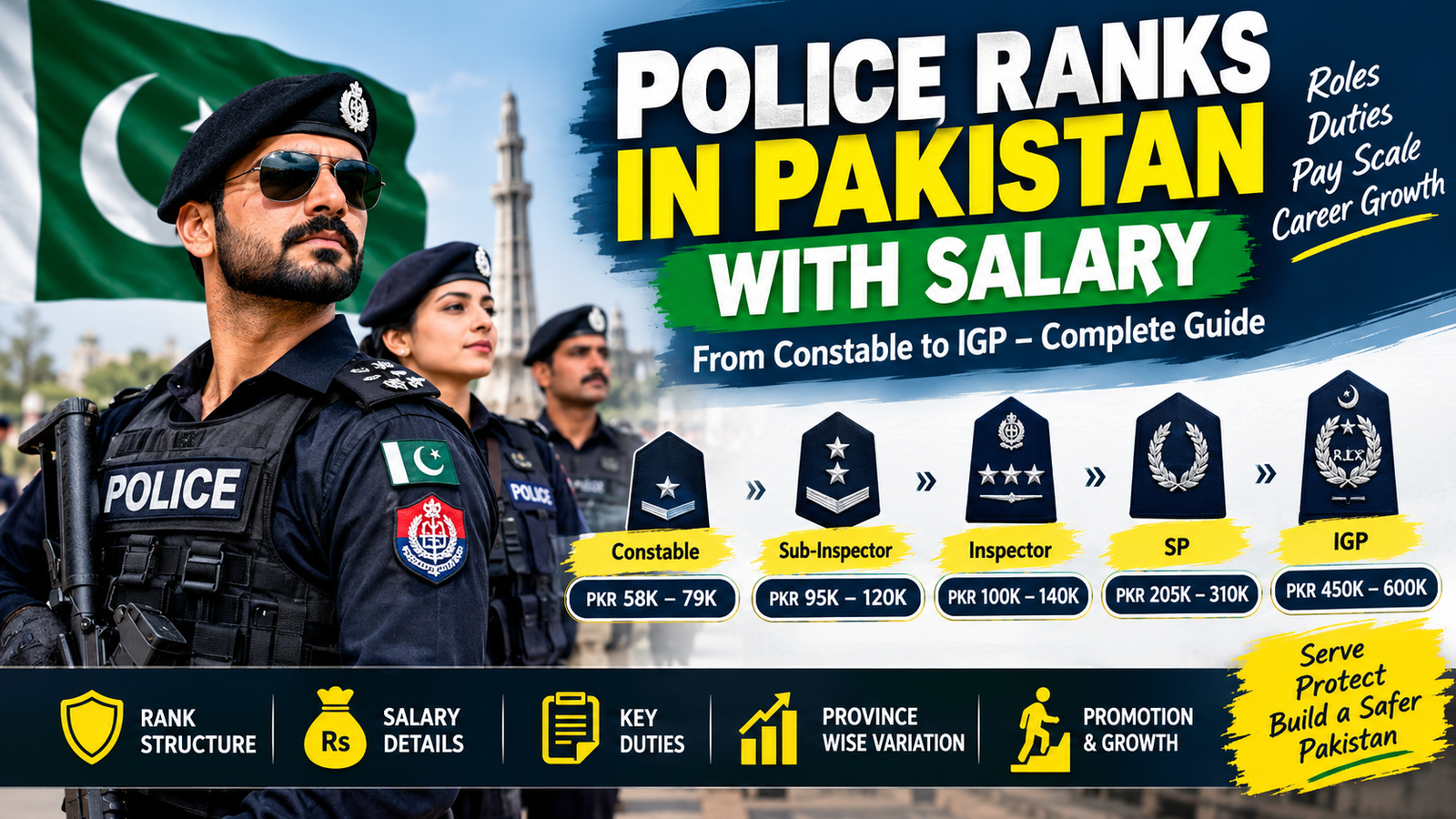
Pakistan’s police force is an essential part of the country’s public safety and justice system. From patrolling streets and responding to emergencies to investigating serious crimes and managing law enforcement operations, police personnel perform a wide range of duties. The department follows a hierarchical structure in which each rank carries specific responsibilities, authority, and opportunities for professional advancement.
For candidates planning to join the police, understanding the different ranks and their salary packages can help them make informed career decisions. This guide explains the police hierarchy in Pakistan, estimated monthly salaries, basic pay scales, major duties, and the factors that influence police officers’ earnings.
Understanding the Police Rank Structure in Pakistan
Police ranks in Pakistan are generally divided into junior, intermediate, and senior officer positions. Most provincial police departments use the federal Basic Pay Scale (BPS) framework, although recruitment rules, allowances, and certain service conditions differ across jurisdictions.
The hierarchy begins with constables and progresses through supervisory ranks to senior leadership positions, including the Inspector General of Police (IGP).
1. Junior Police Ranks and Monthly Salaries
Junior-ranking officers form the operational foundation of the police department. They are directly involved in public interaction, crime prevention, security duties, and the implementation of instructions issued by senior personnel.
Constable — BPS-07
Estimated monthly salary: PKR 58,000–79,000
A constable is generally an entry-level position in the provincial police service. Constables perform regular patrols, help maintain public order, assist during emergencies, and support investigations under the supervision of senior officers.
Their responsibilities may also include traffic management, security at public events, responding to complaints, and protecting crime scenes.
The basic pay scale associated with BPS-07 has historically included a minimum basic salary of PKR 16,310, an annual increment of PKR 910, and a maximum of PKR 43,610 under the cited pay structure. These are basic-pay figures, not the full take-home salary.
Head Constable — BPS-09
Estimated monthly salary: PKR 75,000–95,000
A head constable holds a supervisory position above the constable rank. Depending on the assignment, a head constable may coordinate routine police duties, maintain official records, assist with investigations, and guide junior personnel.
Head constables may also be assigned responsibilities at police stations, checkpoints, or operational units.
The referenced BPS-09 structure lists basic pay from PKR 17,470 to PKR 49,970, with an annual increment of PKR 1,070.
Assistant Sub-Inspector (ASI) — BPS-11
Estimated monthly salary: PKR 85,000–110,000
An Assistant Sub-Inspector performs supervisory and investigative duties. Depending on local rules and the officer’s assignment, an ASI may handle complaints, assist with case preparation, collect evidence, and supervise constables and head constables.
The referenced BPS-11 pay structure starts at PKR 18,910 in basic monthly pay, with annual increments of PKR 1,170 and a maximum basic salary of PKR 56,010.
Sub-Inspector (SI) — BPS-14
Estimated monthly salary: PKR 95,000–120,000
Sub-Inspectors have greater responsibility for police investigations and operational supervision. They may investigate reported offences, question witnesses, prepare case documentation, and coordinate with other officers.
Their precise authority depends on applicable law, departmental rules, and their assigned duties. Some Sub-Inspectors may supervise a police station or unit where formally assigned, while others work in investigation or operational branches.
The cited BPS-14 structure lists a minimum basic salary of PKR 22,530, annual increments of PKR 1,740, and a maximum of PKR 67,960.
Inspector of Police — BPS-16
Estimated monthly salary: PKR 100,000–140,000
An Inspector generally supervises subordinate personnel and may manage a police station, investigation team, or operational unit. The role involves reviewing investigations, monitoring crime-prevention activities, maintaining discipline, and ensuring that official procedures are followed.
The exact responsibilities depend on the posting and the province’s service rules.
The referenced BPS-16 structure begins at PKR 28,070 in basic monthly pay, with an annual increment of PKR 2,260 and a maximum basic salary of PKR 79,770.
2. Senior Police Officers and Their Salaries
Senior officers oversee larger operational areas, coordinate law enforcement strategies, and manage departmental resources. Recruitment and promotion pathways differ, particularly between provincial police services and officers recruited through the federal civil service system.
Assistant Superintendent of Police (ASP) / Deputy Superintendent of Police (DSP)
Grade: Generally BPS-17
Estimated monthly salary: PKR 185,000–280,000
The ASP and DSP ranks are associated with supervisory responsibilities at the subdivision or comparable operational level. ASPs recruited through the Police Service of Pakistan may enter through the Civil Superior Services examination and subsequent training. DSP recruitment and promotion arrangements vary by province.
Typical responsibilities include supervising police stations, reviewing investigations, monitoring law-and-order arrangements, and coordinating responses to significant incidents.
The cited BPS-17 basic pay structure lists a minimum of PKR 45,070, an annual increment of PKR 3,420, and a maximum of PKR 113,470.
Superintendent of Police (SP) — BPS-18
Estimated monthly salary: PKR 205,000–310,000
An SP manages police operations across an assigned area or department. Depending on the posting, the officer may oversee district-level functions, investigations, security arrangements, or specialized police units.
The position requires administrative planning, personnel management, operational decision-making, and coordination with other government departments.
The referenced BPS-18 basic pay structure begins at PKR 59,210, with an annual increment of PKR 4,460 and a maximum of PKR 120,210.
Senior Superintendent of Police (SSP) — BPS-19
Estimated monthly salary: PKR 215,000–320,000
An SSP is a senior officer who may serve in a district leadership role, a specialized branch, or a major administrative assignment. In some jurisdictions and postings, an SSP may serve as District Police Officer (DPO), although the designation and grade of district leadership positions are not identical everywhere.
The officer’s work includes supervising senior subordinates, reviewing crime trends, allocating resources, and ensuring effective policing within the assigned area.
The SSP designation should not be confused with a separate universal salary rate: compensation depends on the officer’s substantive grade, posting, and applicable allowances.
Deputy Inspector General of Police (DIG) — BPS-20
Estimated monthly salary: PKR 315,000–450,000
A DIG usually manages a police range, major operational formation, or senior administrative portfolio, depending on the provincial structure.
Responsibilities can include coordinating multiple districts, evaluating policing performance, overseeing senior officers, and managing major law-enforcement initiatives.
Additional Inspector General of Police (Additional IG / Addl. IGP) — BPS-21
Estimated monthly salary: PKR 350,000–520,000
An Additional Inspector General typically supervises a major provincial police function, region, or specialized department. Assignments may involve counterterrorism, investigations, training, traffic management, operations, or administration.
The role combines strategic planning with oversight of senior officers and departmental performance.
Inspector General of Police (IGP) — BPS-22
Estimated monthly salary: PKR 450,000–600,000
The Inspector General of Police is the highest-ranking police leadership position in a province. The IGP is responsible for overall departmental leadership, strategic priorities, operational oversight, discipline, and coordination with the provincial government.
At the federal level, senior police officers may also hold leadership roles in federal law-enforcement organizations. However, the IGP title and the leadership structure depend on the particular organization.
The salary range shown here is an indicative estimate rather than a guaranteed or uniform pay package.
3. Police Salary Comparison Table
The following table summarizes the approximate monthly salary ranges supplied for this guide.
| Police rank | Typical grade | Estimated monthly salary |
|---|---|---|
| Constable | BPS-07 | PKR 58,000–79,000 |
| Head Constable | BPS-09 | PKR 75,000–95,000 |
| Assistant Sub-Inspector | BPS-11 | PKR 85,000–110,000 |
| Sub-Inspector | BPS-14 | PKR 95,000–120,000 |
| Police Inspector | BPS-16 | PKR 100,000–140,000 |
| ASP / DSP | Generally BPS-17 | PKR 185,000–280,000 |
| Superintendent of Police | BPS-18 | PKR 205,000–310,000 |
| Senior Superintendent of Police | BPS-19 | PKR 215,000–320,000 |
| Deputy Inspector General | BPS-20 | PKR 315,000–450,000 |
| Additional Inspector General | BPS-21 | PKR 350,000–520,000 |
| Inspector General of Police | BPS-22 | PKR 450,000–600,000 |
Important: These are indicative estimates, not verified October 2026 payroll figures. Actual salaries can differ substantially by province, recruitment category, length of service, allowances, and the officer’s current pay stage.
4. Basic Salary vs. Total Monthly Earnings
One of the most important points to understand is the difference between basic pay and gross salary.
Basic pay is the amount assigned to an employee under the applicable pay scale. Gross monthly earnings may also include admissible allowances, such as:
- House rent allowance, where applicable.
- Medical allowance.
- Ad hoc relief allowances notified by the government.
- Conveyance or other applicable allowances.
- Department-specific or special-duty allowances, where authorized.
Not every officer receives every allowance. Eligibility depends on government notifications, departmental policy, location, and the nature of the assignment. Deductions, including taxes and other authorized contributions, can also affect take-home pay.
5. Do Police Salaries Differ Across Provinces?
Yes. Police personnel in Punjab, Sindh, Khyber Pakhtunkhwa, Balochistan, Islamabad Capital Territory, Azad Jammu and Kashmir, and Gilgit-Baltistan may receive different overall compensation packages.
Differences can arise from provincial pay notifications, special allowances, recruitment policies, posting locations, and departmental arrangements. Even two officers with the same BPS grade may receive different gross salaries because their service histories or allowances differ.
For an accurate estimate, candidates should consult the relevant provincial police recruitment notice and the latest official pay and allowance notifications.
6. Career Growth and Promotion Opportunities
Police careers can develop through departmental promotion, qualifying examinations, training, performance assessments, and service requirements. Constables may progress to higher subordinate ranks under applicable rules, while officers entering through competitive civil-service recruitment follow a different career pathway.
Promotion is not automatic. Available positions, seniority, professional qualifications, disciplinary records, and departmental regulations can all influence advancement.
Candidates should therefore consider more than salary when choosing a police career. Training, professional development, public-service responsibilities, work schedules, and the demands of operational duties are also important factors.
Conclusion
Pakistan’s police hierarchy offers career opportunities ranging from frontline constable positions to senior leadership roles. Each rank contributes to public safety through patrols, investigations, supervision, administration, or strategic planning.
Although higher ranks generally carry greater responsibility and may offer higher overall compensation, the exact salary depends on the applicable pay scale, service history, provincial policies, and admissible allowances. Anyone considering a police career should verify the latest official recruitment and salary notifications before relying on a particular figure.
Understanding the rank structure, duties, and compensation system provides a useful starting point for planning a career in law enforcement and appreciating the work performed by Pakistan’s police personnel.